
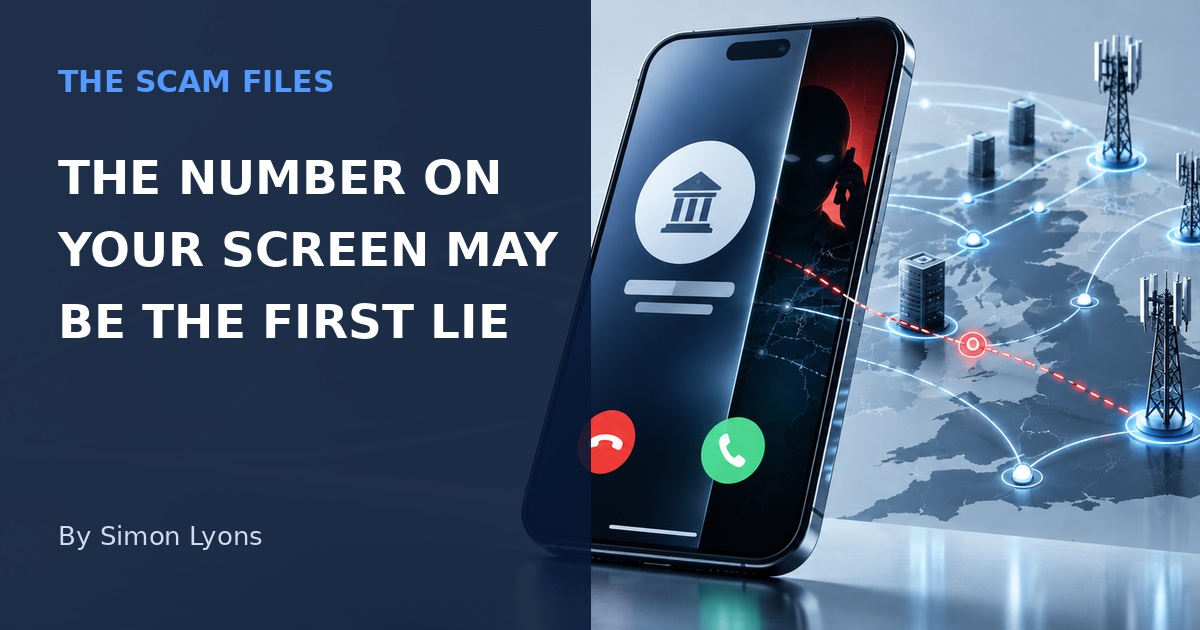
A bank rang me to warn me about a fraudulent transaction.
At least, that was the story.
The call began with an automated message. It sounded polished. I pressed a number and was transferred to a person who spoke confidently, knew how a fraud call should sound and told me the Financial Conduct Authority wanted to speak to me afterwards.
Then he asked me to open my banking app.
I told him I did not bank with the bank he claimed to represent. He did not miss a beat. He said the fraud would appear in whichever banking app I used because they worked with all the major UK banks.
That flexibility was the giveaway. The story changed instantly, but the objective remained the same: get me inside my banking app while he still controlled the conversation.
I recently shared the call on LinkedIn. It stayed with me because it demonstrated how convincing a modern impersonation scam can feel—and how little the number displayed on the screen may tell you about the person actually calling.
The number on your screen is not proof
Caller ID is useful, but it was never designed to be an identity document.
Ofcom explains that criminals can change the number shown on a phone. This is caller ID spoofing. A call can appear to come from a bank, HMRC, a delivery company, a government body or even Ofcom when it is really coming from a fraudster.
That creates a dangerous shortcut in the mind:
- The number looks familiar
- The caller knows the language of fraud prevention
- The automated introduction sounds professional
- The warning creates urgency
- The victim assumes the call has already been authenticated
But recognition is not verification.
The number on the screen is simply part of the presentation. If the presentation can be manipulated, it should never carry the full weight of trust.
The script is built to keep you moving
Good impersonation scams are not just stories. They are journeys.
The criminal creates a threat, offers help and removes the pauses in which the victim might think independently. The automated message creates legitimacy. The human caller creates rapport. The reference to a regulator or police force adds authority. The instruction to open a banking app creates action.
Every stage moves the victim towards the next one.
The fraudster may say:
- There has been a suspicious payment
- Your account is under attack
- Your money must be moved to a safe account
- A regulator is waiting to speak to you
- You must act before the payment clears
- You must not tell anyone because the investigation is confidential
The details vary. The mechanism is remarkably consistent: authority, urgency and isolation.
The victim is discouraged from ending the call, contacting the organisation independently or discussing the situation with somebody else. That is not accidental. Those simple actions break the criminal's control of the journey.
A local voice does not make the call local
One feature of the call surprised me: the voice sounded local and the line was clear.
People sometimes carry a mental picture of what a scam call sounds like. That picture is now actively unhelpful. A fraudster may be overseas or nearby. The voice may be natural, altered, scripted or generated. The line may be poor or perfect.
An accent is not a fraud control. Call quality is not a fraud control. Familiarity is not a fraud control.
The useful questions are behavioural:
- Did I expect this call?
- Is the caller creating urgency?
- Are they asking me to disclose a password, PIN or security code?
- Are they telling me to move money?
- Are they asking me to install software or share my screen?
- Are they resisting my attempt to hang up and verify the situation independently?
The FCA states that it will not ask people to transfer money to it and warns that its own switchboard numbers can be spoofed. A caller invoking the FCA is not evidence that the FCA is involved.
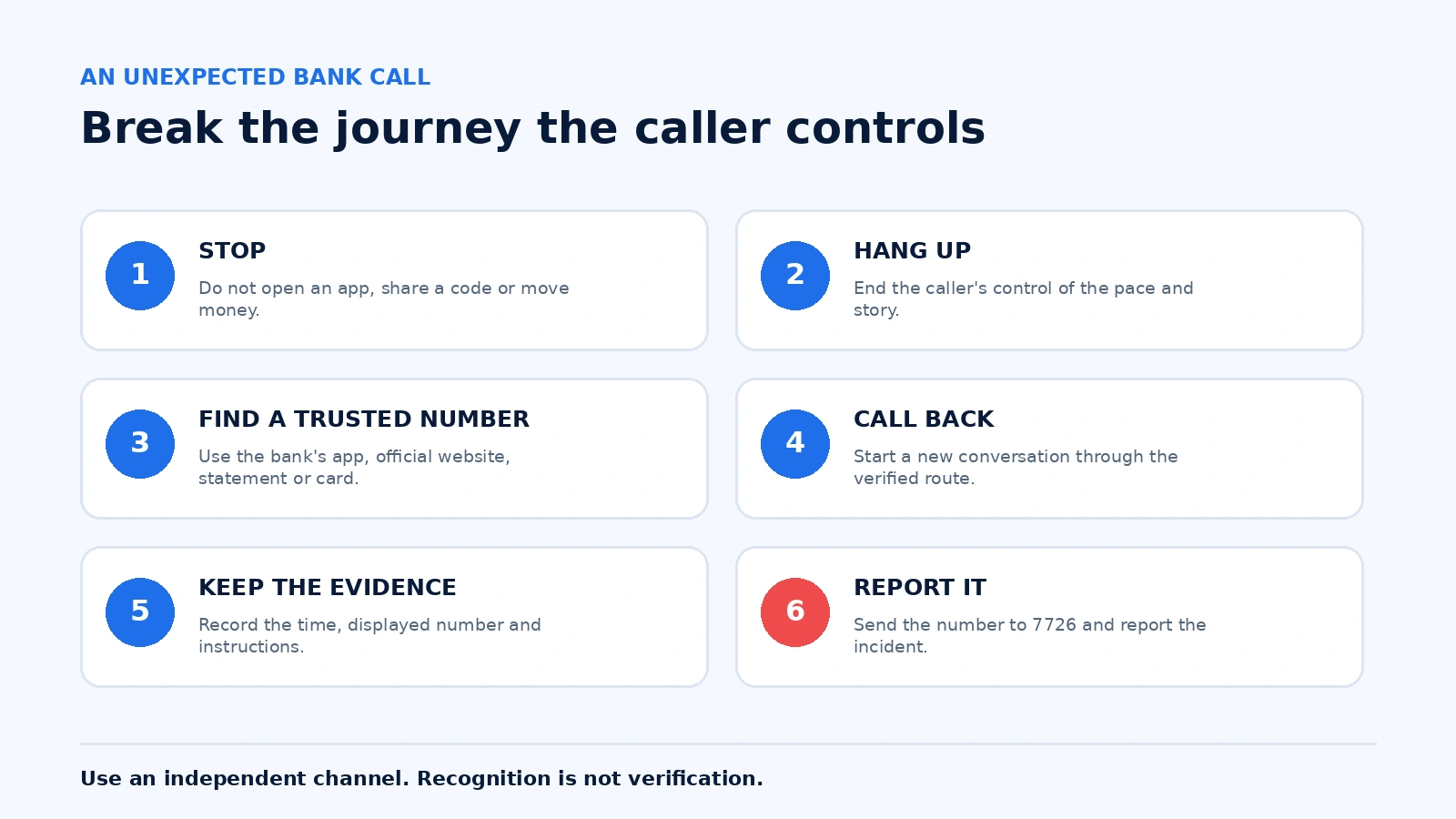
The safest response to an unexpected fraud call is not to win an argument with the caller. It is to end the journey they control and start a new one through a channel you trust.
Break the journey before it reaches the payment
If an unexpected caller claims to be from a bank, regulator, police force or other trusted organisation, the response should be simple.
- Stop. Do not open an app, disclose a security code or move money because an incoming caller told you to.
- Hang up. Ending the call removes the criminal's ability to control the pace and narrative.
- Find the number independently. Use the organisation's official website, the number on the back of your bank card or a verified statement. Do not use a number supplied during the call.
- Call back through the trusted route. Explain what happened and ask the organisation to check the account.
- Preserve the evidence. Keep the time of the call, the displayed number, messages and any payment details or instructions you received.
- Report it. Ofcom advises forwarding the suspicious number to 7726, which alerts the mobile provider. Fraud can also be reported through the UK's Report Fraud service.
If money has already moved, contact the bank immediately. Speed matters.
Reporting should not depend on who you know
The call also exposed a wider problem.
People working in fraud prevention often know individuals at banks, telecoms companies and law-enforcement bodies. They may be able to find an informal route to somebody who can examine a number, an account or a pattern.
The public should not need that network.
I have previously written about the gap people encounter when they try to report suspected mule accounts without being a customer of the receiving bank. The same frustration can appear with suspicious telephone numbers. A person may have useful intelligence but no obvious path to the organisation capable of acting on it.
The launch of the new Report Fraud service is an important improvement, and the Government's 2026–2029 Fraud Strategy places greater emphasis on coordinated disruption. But reporting only creates value if the intelligence can reach the right organisation quickly enough to be investigated, connected to other reports and acted upon.
A report should not disappear into a queue. It should become part of a pattern.
One spoofed number may be weak evidence. The same script, payment destination, device, voice, telecom route or account appearing across multiple reports may be far more useful.
What banks, telecoms firms and platforms can do
Consumers need clear advice, but this cannot be solved by telling people to be more careful.
Organisations control the systems criminals exploit. They also hold different pieces of the evidence.
Make genuine contact easy to verify
Banks and public bodies should publish clear callback instructions and make it easy for customers to reach a trusted fraud channel from their app or official website.
Remove ambiguity from customer warnings
Warnings should be specific. Banks, regulators and the police will not ask customers to move money to a safe account. That message should be repeated consistently at the moment a customer is most likely to need it.
Protect numbers that should never make outbound calls
Ofcom's Do Not Originate list records numbers reserved for inbound calls. If a call appears to come from one of those numbers, it should not be treated as genuine outbound traffic.
Join the evidence across sectors
The bank may see the payment. The telecoms provider may see call routing. The platform may see the advert or initial contact. Law enforcement may see related reports. No single organisation sees the whole scam.
Useful disruption depends on secure, lawful and timely information sharing between the organisations that hold those fragments.
Measure disruption, not only reimbursement
Reimbursing a victim matters. Preventing the next call matters too.
The strongest response links the complaint to the number, account, script, device, advert and other identifiers available, then uses that intelligence to block, investigate or warn elsewhere.
The real lesson from the call
The fraudster who called me was confident because he believed the systems around him would not move quickly enough to identify or stop him.
That confidence should concern us more than the quality of his script.
The answer is not blind faith in caller ID, nor is it suspicion of every genuine call. It is a better trust model:
- Treat an unexpected incoming call as unverified
- Let the customer end the call without pressure
- Re-establish contact through an independent, trusted channel
- Capture the evidence consistently
- Connect reports so repeated infrastructure and behaviour can be seen
- Give banks, telecoms companies, platforms and law enforcement routes to act together
The number on the screen may be the first lie. The safest response is to stop following the caller's journey and create your own.
Read more of Simon's direct observations on fraud, scams, payments and open banking.
Follow Simon Lyons on LinkedIn ->Frequently asked questions
If it's not here, ask us directly — we reply within one UK business day.